BCAPI’s response to GNB’s Anglophone Sector Education Plan
On May 13, the Telegraph Journal published an op-ed submitted by BCAPI’s co-chairs, Ryan Mitchell and Andy Carson – which made five key policy recommendations for GNB’s upcoming Anglophone Education Plan.
Expand subsidized daycare for low-income families and eliminate the employment eligibility requirement for families receiving social assistance.
Establish mandatory teacher-led kindergarten readiness testing at the beginning of school.
Conduct regular literacy and numeracy skills assessments throughout grades K-3, apply appropriate tracking and timely interventions, and ensure competency prior to grade 4 (literacy) and 5 (numeracy) standardized testing.
Re-examine skill-based student retention and promotion practices.
Recognize poverty as a proven learning barrier requiring sufficient resources to ensure children’s learning gaps are closed at every grade level from early childhood to Grade 12.
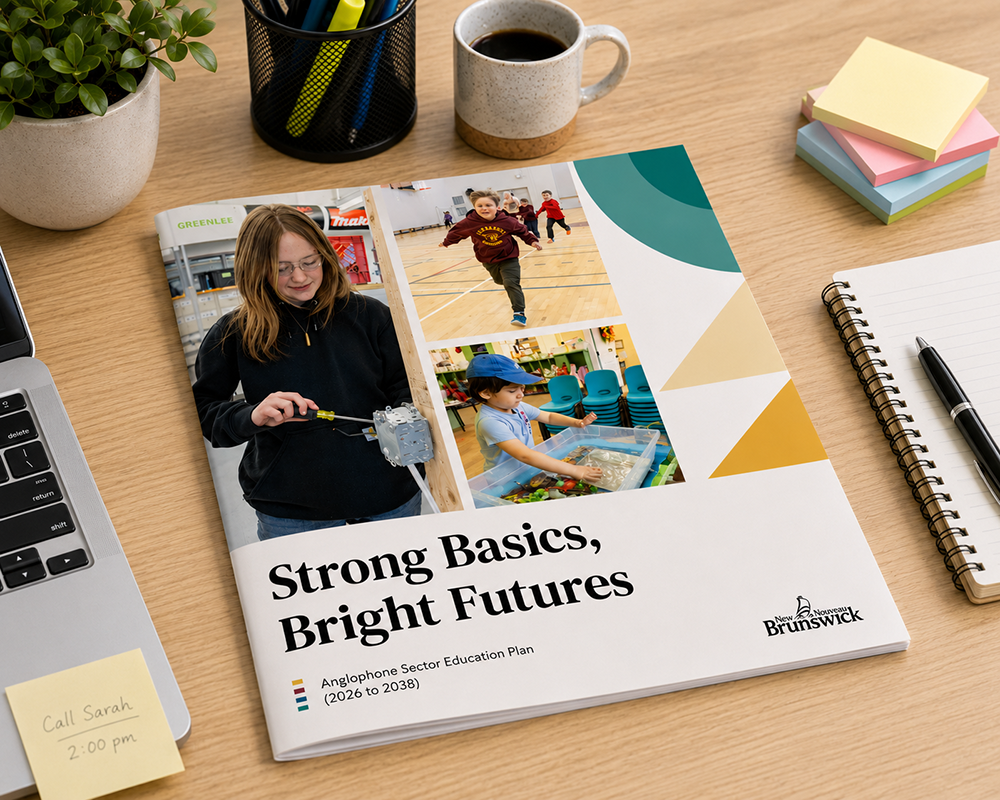
On May 25, the Anglophone Sector Education plan was released, and we were pleased to note substantial alignment with our recommendations.
Recommendations 2, 3 and 4 are the most tightly aligned with the new plan, and we are generally comfortable with how they are framed.
Recommendations 1 and 5 were least tightly aligned with the new plan – and we are concerned these omissions could limit the plan’s potential for success.
That said, we are encouraged by the following three mentions in particular:
The plan explicitly links inclusion and equity as two separate but equally important principles. We believe concept of equity has the potential to expand the inclusion conversation to include the consequential learning barriers that result from living in poverty from an early age.
The following action in the Continuous Improvement and Innovation section recommends differential funding – a needs-based approach to funding both students and schools which could be used to address low-socio-economic-status learning barriers: “Establish consistent needs-based classroom expectations for funding based on student and school needs.”
Also in the Continuous Improvement and Innovation section, under School Innovation Pilots, we see the following mention, which could create a province-wide scaling framework for proven projects like When Children Succeed: “Effective school practices are identified, validated, and expanded across the education system.”
In general, the plan is a good one – but it will take a substantial coordinated effort to successfully implement.
Read the op-ed:
https://www.bcapi.ca/news/a-new-vision-for-new-brunswicks-youngest-learners
Read the Education plan:
https://www.gnb.ca/content/dam/GNB3/t/et-ef/km-12/afp/doc/25-02598-anglophone-education-plan.pdf